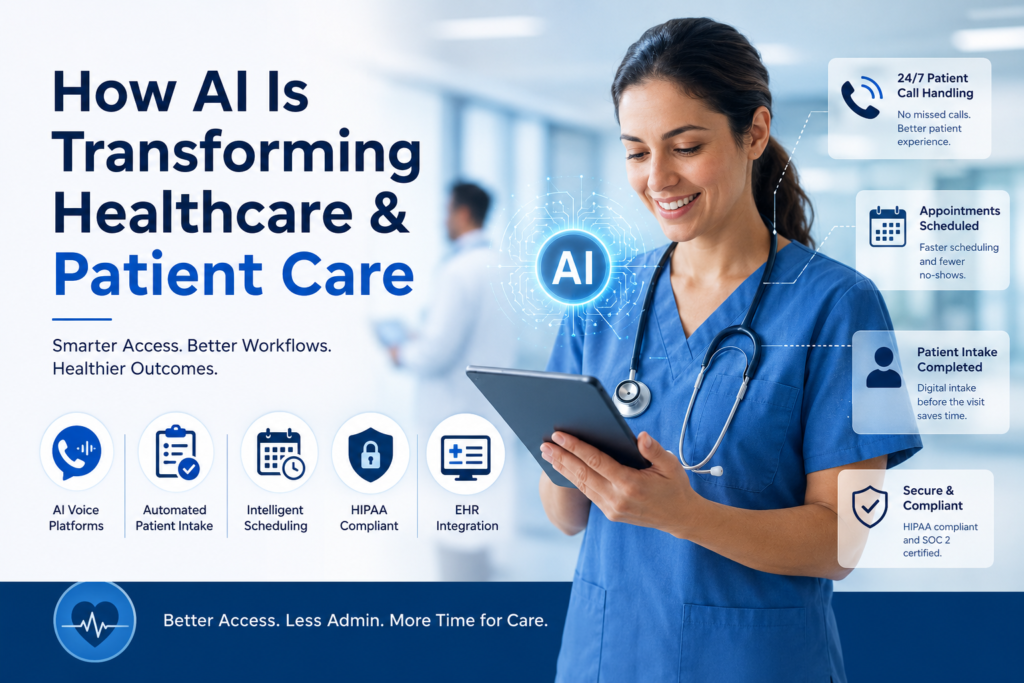
Healthcare has always been about people, but for decades, the systems built to support it have let people down. Missed calls, long hold times, buried paperwork, and overworked staff have quietly eroded patient trust and clinic revenue. Today, artificial intelligence in healthcare is rewriting that story, not by replacing clinicians, but by removing the friction that keeps patients from getting the care they need.
From intelligent appointment scheduling to fully automated patient intake workflows, AI is becoming the invisible backbone of modern medical practices. And for healthcare leaders, the question is no longer whether to adopt AI, it is how fast they can implement it responsibly.
1. The Access Crisis Hiding in Plain Sight
Before diving into the technology, it helps to understand what problem it is solving. Across the United States, mid-sized medical practices fielding 500 or more inbound calls per day face a painful operational reality:
- 12–18% of calls go unanswered or abandoned
- Average hold times stretch to 3–6 minutes
- Staff spend significant portions of their day on repetitive scheduling requests
The downstream effect is stark. Research shows that up to 60% of patients will consider switching providers after a poor access experience. Every missed call is not just a scheduling failure, it is a lost relationship, and potentially a lost life-saving intervention. This is the access crisis that healthcare AI is being built to solve.
2. What AI in Healthcare Actually Looks Like in 2025–2026
The term ‘AI in healthcare’ can conjure dramatic images of robots performing surgery. The reality today is both more practical and arguably more impactful. The most transformative AI applications in healthcare right now are happening in medical practice automation, the unglamorous but critical workflows that determine whether a patient gets seen or slips through the cracks.
AI Voice Platforms and Intelligent Call Routing
One of the fastest-growing categories in healthcare AI is the AI voice platform, a system that answers patient calls instantly, interprets intent using natural language understanding, and routes or resolves the inquiry automatically. Unlike old-fashioned IVR phone trees (‘Press 1 for billing, Press 2 for scheduling’), modern AI voice systems hold genuine conversations.
They can confirm insurance details, reschedule a missed appointment, process a prescription refill request, and detect urgency, all without putting a patient on hold. When human intervention is genuinely needed, these platforms transfer the call with full context already populated, so staff never ask a patient to repeat themselves.
Automated Patient Intake
Another high-impact area is patient intake automation. Traditionally, intake means a stack of clipboards in the waiting room or a confusing patient portal that nobody uses. AI-powered intake platforms now handle pre-registration, insurance verification, and consent forms before the patient ever walks through the door.
Industry data from 2026 shows that 68% of patients prefer a hybrid intake experience — one where they can complete paperwork on their own schedule digitally, confirmed in person at arrival. Practices that deliver this see higher show rates, reduced no-shows, and significantly shorter average check-in times.
EHR Integration: The Glue That Makes It Real
None of these capabilities deliver lasting value without deep, native EHR integration. An AI that schedules appointments but cannot write them into Epic, Cerner, or athenahealth creates more problems than it solves. The gold standard for AI deployment in healthcare today requires real-time, bidirectional integration with existing clinical systems, no workflow redesign, no parallel data entry.
3. Real-World Example: How CuroAI Solved Patient Access for Growing Clinics
This is where experience meets technology. The following example draws on CuroAI’s clinical deployment model, built by operators who have spent over 21 years running high-volume patient access environments across 17 health networks.
Consider a multi-specialty outpatient clinic operating across three locations, handling over 600 inbound calls per day. Before deploying an AI voice solution, the clinic’s front desk team was overwhelmed. Call abandonment hovered around 15%, hold times regularly exceeded five minutes, and staff turnover was increasing — a direct symptom of cognitive overload from repetitive task handling.
The clinic implemented CuroAI, an AI voice platform built specifically for healthcare. The deployment followed a structured four-week validation framework:
- Week 1–2 — Workflow Mapping: CuroAI ingested 30 days of historical call data, identifying the top call drivers: appointment scheduling (42%), prescription refill requests (21%), billing inquiries (18%), and clinical triage escalations (19%).
- Week 3 — Controlled Pilot Launch: The AI went live on a test phone line, handling scheduling and refill workflows while the clinical team monitored accuracy, tone, and escalation behavior in real time.
- Week 4 — Full Deployment: After KPI thresholds were met, the system expanded to full inbound coverage. CuroAI’s intelligent routing engine achieved 98% accuracy in directing callers to the correct department or completing their request autonomously.
Within 60 days of full deployment:
- Call abandonment dropped from 15% to under 2%
- 52% of routine calls were handled end-to-end by the AI — no staff involvement needed
- Front desk staff were redeployed to higher-value patient interactions
- Modeled annual revenue recovery exceeded $1.4M based on call capture improvements
Critically, the system was HIPAA compliant from day one, SOC 2 Type II audited, with AES-256 encryption on all calls and data, and Business Associate Agreements in place for every healthcare customer. In a sector where trust is everything, compliance is not an afterthought; it is the foundation.
4. Why AI Governance Matters as Much as AI Capability
For any organization evaluating medical practice automation, capability is only half the equation. The other half is trust and in 2026 healthcare AI governance is becoming a core clinical competency, not just an IT concern. When assessing an AI vendor for clinical use, the questions that matter most are often the ones that go beyond product demos and feature lists.
- Has the vendor actually been in the room? There is a meaningful difference between AI built in a lab and AI that has been stress-tested in live clinical environments, handling edge cases, managing escalations, and navigating the unpredictable volume and complexity of real patient communications. Deployment experience shapes how a product behaves when things do not go according to plan.
- Do they speak the language of healthcare? Generic automation tools designed for retail or customer service rarely translate cleanly into clinical settings. Specialty-specific scheduling logic, triage escalation thresholds, and EHR data structures require purpose-built understanding. A vendor that genuinely knows healthcare workflows is fundamentally different from one that has adapted a general-purpose platform.
- Are the credentials there and are they the floor, not the ceiling? HIPAA compliance and SOC 2 Type II certification should be treated as baseline requirements, not selling points. The more telling question is what a vendor has built beyond those minimums, in terms of audit practices, clinical oversight, and accountability structures.
- Can patients and clinicians actually rely on it? The strongest healthcare AI platforms are defined as much by what they refuse to do as by what they can do. Hard clinical safety guardrails, including clear definitions for when the AI must escalate and an absolute prohibition on providing medical advice, are what distinguish tools suitable for clinical settings from those that merely claim to be.
Governance is not a compliance checkbox. It is the foundation on which clinical trust is built, and in healthcare automation, trust is the product.
5. What Healthcare Leaders Should Prioritize When Evaluating AI
If you are a practice administrator, healthcare executive, or clinical operations leader evaluating AI solutions, here are the questions that matter most:
- Does it integrate with your existing EHR? Deploying AI that requires a parallel workflow or manual data reconciliation defeats the purpose. Look for native, real-time EHR integration with the systems you already use: Epic, Cerner, athenahealth, eClinicalWorks, and others.
- What is the validation process before go-live? Any responsible AI vendor should require a controlled pilot phase with real call data before full deployment. Skip any vendor who wants to go live in 48 hours.
- How does it handle clinical escalation? The highest-risk moment in patient communication automation is when a caller has a clinical question or emergency. A robust AI voice platform must have clearly defined escalation pathways with immediate human handoff and full context transfer.
- What does compliance look like in practice? HIPAA compliance is the legal floor. Ask specifically about SOC 2 certification, encryption standards, audit trail capabilities, and BAA availability.
The Bottom Line
Artificial intelligence is not replacing healthcare. It is repairing it, filling the gaps in access, reducing the administrative burden crushing clinical staff, and creating the kind of frictionless patient experience that modern healthcare demands.
The practices that will thrive in the next five years are those that move beyond experimentation and implement AI in ways that are validated, compliant, and deeply integrated with their existing clinical operations.
Platforms like CuroAI represent what this looks like in practice: an AI voice platform built by healthcare operators, for healthcare operators, with the clinical-grade safety guardrails, EHR integration, and HIPAA compliance that this industry requires. The question is not whether your practice should adopt AI. The question is whether you can afford to wait any longer.
FAQs
What is AI in healthcare?
AI in healthcare refers to technologies that use machine learning, natural language processing, and automation to support administrative, operational, and clinical workflows. Common examples include appointment scheduling, patient intake automation, call routing, and documentation assistance.
How does AI improve patient access?
AI can answer calls instantly, route patients to the right department, automate scheduling and rescheduling, and reduce hold times. This helps clinics respond to more patients without increasing staff workload.
What is patient intake automation?
AI-powered patient intake automation digitizes tasks such as registration forms, insurance verification, consent collection, and pre-visit questionnaires. Patients can complete these steps before arriving, reducing check-in time and administrative effort.
Does AI replace healthcare staff?
No. Most healthcare AI tools are designed to handle repetitive administrative tasks so staff can focus on higher-value patient interactions, care coordination, and clinical responsibilities.
Why is EHR integration important for healthcare AI?
EHR integration allows AI systems to read and update patient records in real time. Without integration, staff may need to re-enter information manually, which increases errors and reduces efficiency.